
The Three Eras of Money
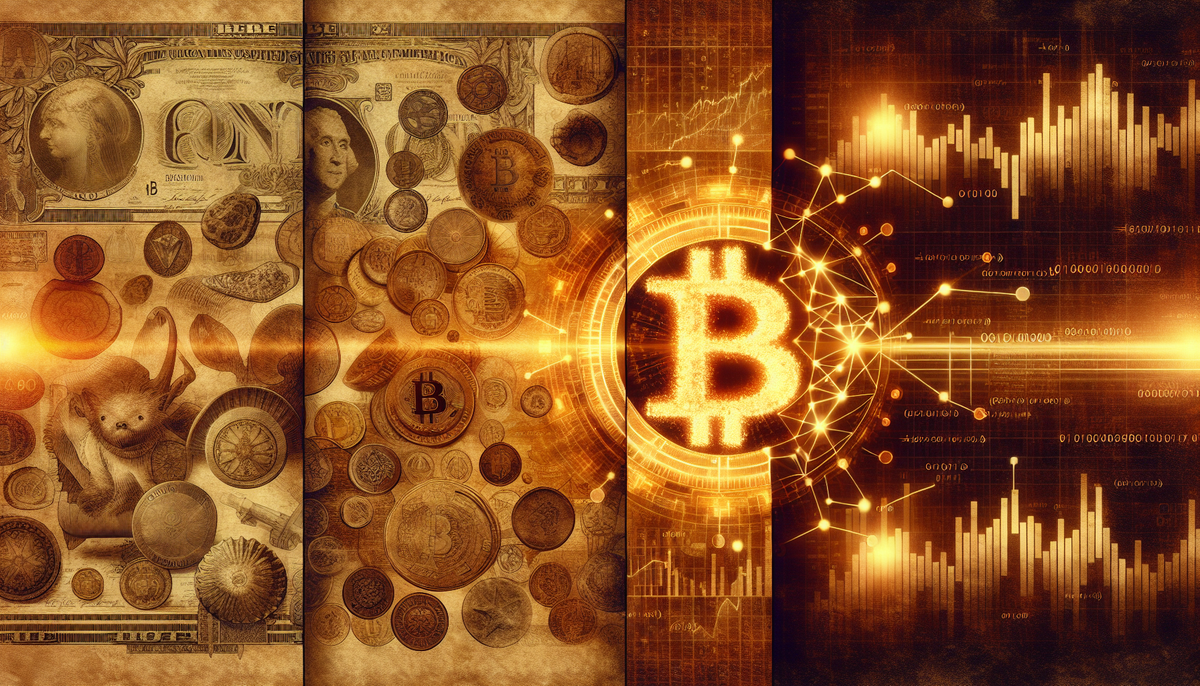
Most people assume money has always worked the way it does today — paper bills backed by government promise, numbers in bank accounts, central banks setting interest rates. But this is a remarkably recent development in the long history of exchange.
Money has evolved through three distinct eras, each defined by what gives it credibility. Understanding these eras reveals not just where we've been, but where we're heading.
Era 1: Commodity Money
For thousands of years, money was backed by physical properties. Gold, silver, salt, shells, and other commodities served as money because they were scarce, durable, divisible, and recognizable. Their value came from their material substance.
Gold became the dominant form because it possessed these properties in abundance. It was scarce enough to hold value, soft enough to divide and mark, and chemically stable enough to last generations. When someone handed you a gold coin, you could verify its weight and purity. No intermediary was required.
The credibility of commodity money came from physical reality itself — you could weigh it, test it, and store it.
This system had natural constraints. The money supply grew only as fast as new commodities could be extracted or harvested. Governments could debase coins by mixing in cheaper metals, but the fraud was eventually detectable. The physical nature of the money imposed discipline.
Era 2: Political Money
The second era began gradually as governments issued paper claims on commodity reserves, but it accelerated dramatically on August 15, 1971. That day, President Nixon severed the dollar's link to gold, completing the shift to pure fiat currency.
Fiat money is backed not by physical substance but by political decree — the Latin word "fiat" means "let it be done." Its value rests entirely on government command and the legal obligation to accept it for debts and taxes. Modern electronic debt-based fiat currency exists primarily as numbers in databases, created through lending by central and commercial banks.
The credibility of political money comes from state power — the ability to compel acceptance through legal tender laws and the threat of force.
This system removed the natural constraints of the commodity era. Central banks can expand money supply with keystrokes. Governments can finance deficits without the discipline of gold convertibility. The money supply is now a policy variable, adjusted to achieve economic objectives.
The trade-off became visible over decades: flexibility in monetary policy, but steady erosion of purchasing power. What a dollar could buy in 1971 requires roughly eight dollars today.
Era 3: Mathematical Money
Bitcoin introduced a third model in 2009: money backed by mathematical proof. Its credibility comes not from physical properties or political command, but from cryptographic verification and consensus rules enforced by software.
The supply is fixed by algorithm at 21 million units. No individual, company, or government can increase this limit. Transactions are verified by a global network of computers solving cryptographic puzzles, making the ledger tamper-resistant without requiring trust in any central authority.
Anyone can verify the entire transaction history and current supply. The rules are transparent and enforced by code, not discretion. Ownership is proven through private keys, not identity documents or bank accounts.
The credibility of mathematical money comes from verifiable computation — anyone can prove the supply, validate transactions, and enforce the rules independently.
This system combines features from both previous eras while eliminating their weaknesses. Like commodity money, it has strict supply constraints and doesn't require trust in intermediaries. Like political money, it's purely digital and easily transferable. Unlike both, its rules can't be changed by force or decree — only by voluntary consensus among users.
Comparing the Three Eras
| Feature | Commodity Money | Political Money | Mathematical Money |
|---|---|---|---|
| Credibility Source | Physical properties | State authority | Cryptographic proof |
| Supply Constraint | Natural scarcity | Policy discretion | Algorithmic limit |
| Verification | Weight and purity tests | Trust in issuer | Open computation |
| Transfer Mechanism | Physical delivery | Bank intermediaries | Peer-to-peer network |
| Rule Changes | Impossible (physics) | Centralized decision | Voluntary consensus |
| Key Weakness | Storage and transport costs | Inflation risk | Adoption and volatility |
Why This Matters for Investors
Understanding these eras frames the investment opportunity. We're witnessing a transition between monetary systems — a shift that happens perhaps once or twice per century.
The political money era delivered unprecedented flexibility but also unprecedented monetary expansion. Central bank balance sheets have grown from millions to trillions. Debt-to-GDP ratios have reached levels previously seen only during world wars. Purchasing power has steadily declined.
Mathematical money offers an alternative with fundamentally different properties. Fixed supply. Open verification. No trusted intermediaries. These characteristics attract those seeking protection from monetary debasement.
The question isn't whether Bitcoin will completely replace fiat currency tomorrow. The question is whether an alternative monetary system with algorithmic scarcity and cryptographic verification will claim meaningful share in a world of expanding political money supply.
History suggests monetary systems eventually reflect their internal logic. Commodity money failed when governments needed more flexibility than gold allowed. Political money is straining under the weight of its own promises. Mathematical money offers properties that address the weaknesses of both predecessors.
Investors who understand this framework can position themselves accordingly. The three eras of money aren't just history — they're a roadmap for understanding the present and anticipating the future.
This is for education only and shares personal opinions. It is not investment, legal, accounting, or tax advice. Investing carries risk, including loss of principal. Do your own research and consult professionals. Examples, ranges, and policies are illustrative and may not suit your situation. The author may hold positions in the assets discussed.

Comments ()